Business Resilience & Third-Party Risk Management Singapore | Applied Risk

0
0
Hire Risk Expert
You agree to our Terms and Conditions of Use, PDPA & Privacy Policy and Cookies Policy

Resiliency & Third-Party Risk

How Resilient Is Your Business When Others Fail?

Your business may be well managed internally, but some of its biggest vulnerabilities can sit outside the organisation.
Suppliers, technology providers, logistics partners, contractors and outsourced services can all become critical to day-to-day operations.
Understanding those dependencies helps you prepare for disruption before it reaches your customers, finances or reputation.

Assess Your Business Resilience →

Why This Matters

A supplier may look reliable today and still become a problem tomorrow. Financial difficulties, cyber incidents, regulatory issues, transport disruption, geopolitical events or operational failures can quickly affect the services and products your business depends on.

Third-party risk management and operational resilience help you understand:

  • which suppliers and partners are genuinely critical;
  • where your organisation has single points of failure;
  • whether important third parties can recover from disruption;
  • how much disruption your business can tolerate; and
  • what alternatives are available if something goes wrong.
Key Statement
Resilience is not about preventing every disruption. It is about being prepared to continue when disruption happens.

What Are You Worried About?

  • What if a key supplier suddenly fails?
  • Are we too dependent on one provider?
  • Could a cyber incident at a vendor affect us?
  • Can our business continue during disruption?
  • Do we know which third parties are truly critical?

Key Risk Areas

Third-Party Risk Assessment
Supplier Due Diligence

Business Continuity

Operational Resilience

Supplier Dependency Risk

Third-Party Monitoring
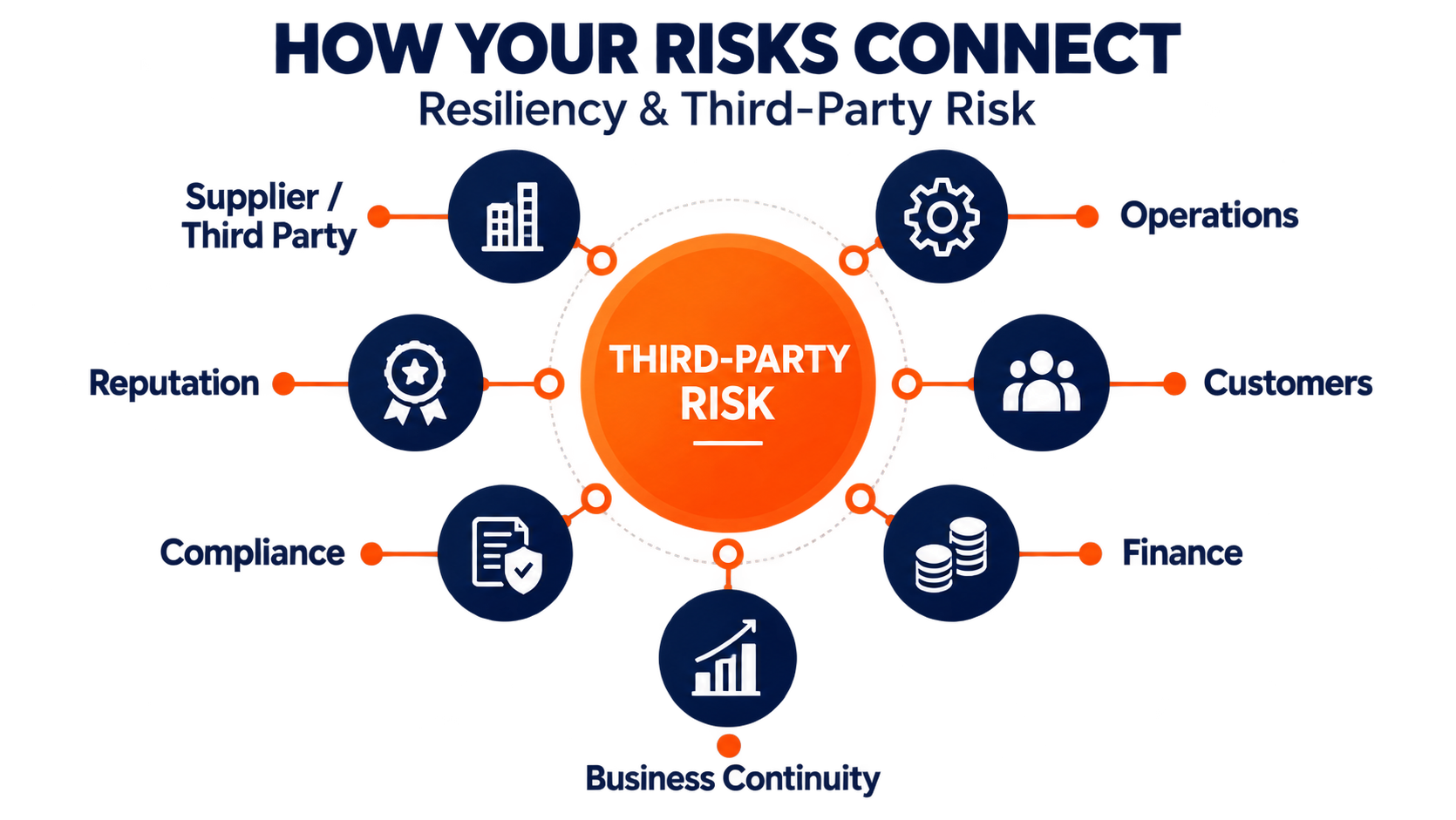
How Your Risks Connect

A third-party problem rarely stays with the third party.  A supplier interruption can delay operations. Delays may affect customers. Customer issues can create financial pressure, contractual problems and reputational damage.  The same applies to technology providers. A cyber incident at an external service provider may become your operational, regulatory and customer problem too.  Looking at the connections helps management understand the business impact, rather than only the supplier's individual risk.
A third-party problem rarely stays with the third party. A supplier interruption can delay operations. Delays may affect customers. Customer issues can create financial pressure, contractual problems and reputational damage. The same applies to technology providers. A cyber incident at an external service provider may become your operational, regulatory and customer problem too. Looking at the connections helps management understand the business impact, rather than only the supplier's individual risk.

How We Assess Your Risk Health

  1. 1

    Identify Critical Dependencies


    Understand the suppliers, systems, facilities and external partners your business relies on to deliver important services.
  2. 2

    Assess Impact & Controls


    Consider what happens if those dependencies fail and whether your existing controls, alternatives and recovery arrangements are sufficient.
  3. 3

    Strengthen Resilience


    Prioritise practical measures such as alternative suppliers, better monitoring, contractual protections and continuity plans.

How Resilient Would Your Business Be During a Disruption?

A disruption at a supplier, technology provider or service partner should not automatically become a crisis for your organisation. Understanding your dependencies gives you more time to prepare alternatives, strengthen controls and make informed decisions when conditions change. Speak with our risk professionals about your third-party and resilience risks.